
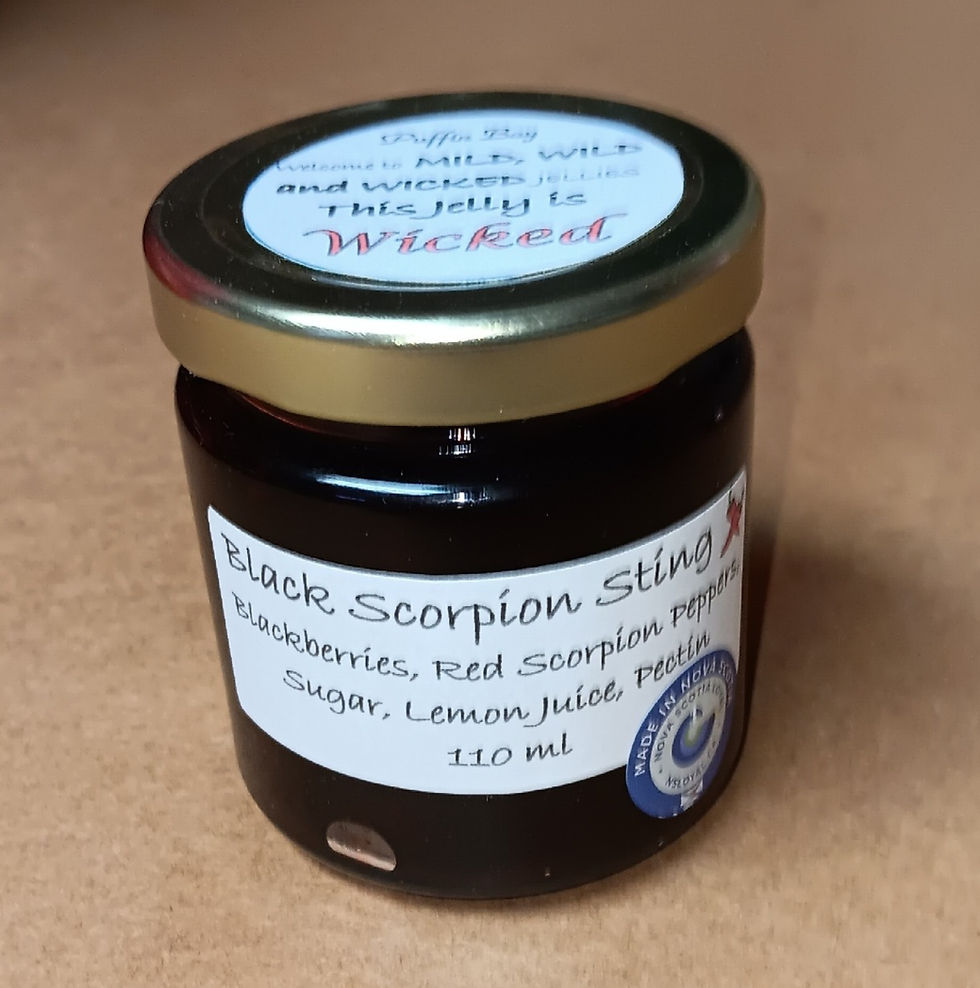
Your BlackJack and Black Scorpion Sting both have the same recipe and both are made with Red Scorpion Peppers.
Please note that many of our “MILD” jellies have NO hot peppers in them. They are a flavourful combination of fruits and spices. They contain the fruit juices from naturally pressed fruit along with spices specific to that jelly and no additives or artificial colouring.
Q: Your BlackJack and Black Scorpion Sting both have the same recipe and both are made with Red Scorpion Peppers. Why is BlackJack labelled MILD and Black Scorpion Sting labelled WICKED.
A: That is an excellent question and it reflects the overall question of “Where does the heat come from in hot pepper?”
The "heat" in hot peppers isn't actually a flavour—it's a chemical reaction. Here is the breakdown of where that fire comes from and how it works:
1. The Chemical Source: Capsaicin
The spicy sensation is caused by a group of chemical compounds called capsaicinoids, the most famous being capsaicin.
· Function: In nature, capsaicin evolved as a dense mechanism to stop mammals (who have teeth that grind and destroy seeds) from eating the fruit.
· Immunity: Interestingly, birds lack the receptors to feel this heat, allowing them to eat the peppers and spread the seeds intact through their droppings.
2. The Hottest Part of the Pepper
Contrary to popular belief, the seeds are not the spiciest part.
The Pith (Placenta): The highest concentration of capsaicin is found in the white, spongy membrane (pith or placenta) that holds the seeds.
The Seeds: While the seeds may taste hot, it is only because they are in direct contact with the pith and get coated in capsaicin oil. That may be why (among other practices), the longer you leave a pepper on the plant before harvesting the hotter it seems to get.
The Flesh: The outer skin and flesh contain the least amount of heat, but add the flavour generic to that pepper.
3. How it "Tricks" Your Brain
When you eat a pepper, capsaicin binds to a specific receptor in your mouth called TRPV1.
The False Alarm: This receptor is normally responsible for detecting actual physical heat (like scalding water).
The Sensation: Capsaicin "tricks" this receptor into sending a signal to your brain that your mouth is literally on fire, even though there is no real temperature increase.
The Rush: Because your brain thinks you are in pain, it releases endorphins and dopamine, which is why many people enjoy the "high" of eating spicy food.
4. Measuring the Heat
The intensity is measured using the Scoville Scale, which ranks peppers in Scoville Heat Units (SHU). See the following examples below:
Bell Pepper: 0 SHU (no capsaicin).
Jalapeño: 2,500 – 8,000 SHU.
Carolina Reaper: ~2.2 million SHU.
Pepper X: Currently the world's hottest at ~2.69 million SHU.
Pro-Tip: If you’ve overdone the spice, reach for milk rather than water. Capsaicin is an oil and doesn't dissolve in water (or beer); however, the protein casein found in dairy acts like a detergent to break the capsaicin bond from your receptors.
5. Balancing the amount of heat in the two jellies you mentioned.
· By using only the seeds in small quantities we can produce a flavourful blackberry jelly with a nominal amount of heat. (BlackJack)
· By adding a judicial combination of the pith and seeds we can maintain the blackberry flavour but notch the heat up a little to a “WICKED” jelly. (Black Scorpion Sting)
· Please note that we could make it “BEYOND WICKED” by intensifying the amount of pith and seed used, but we would lose the flavour of the blackberries.

Comments