
What is the Scoville Scale?
Q: You refer to the Scoville Scale and SHU in determining the heat of your peppers. What are they?
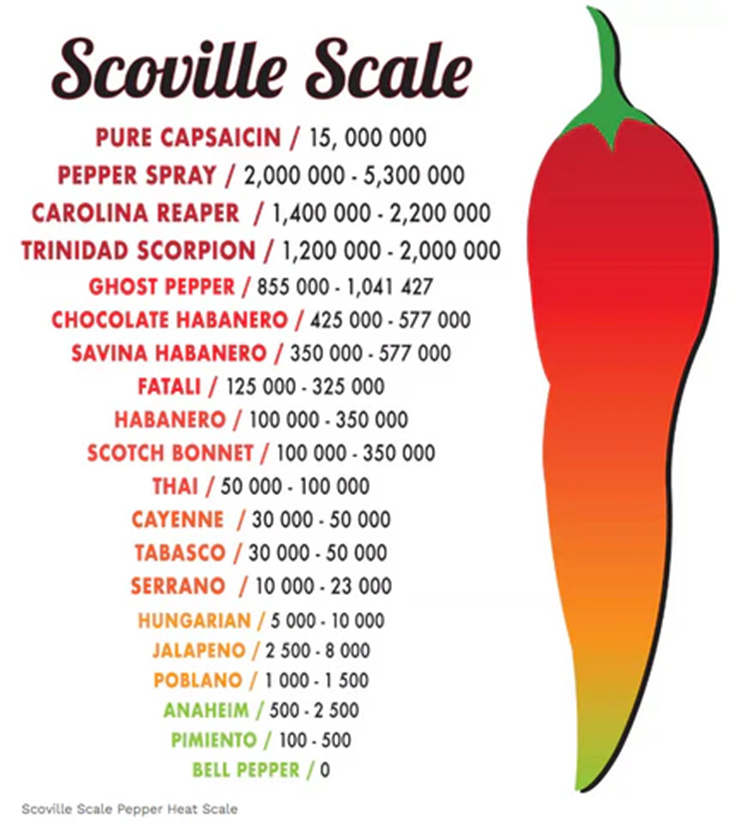
A: This is the standard and accepted way of determining the heat level of each pepper classification and is measured in Scoville Heat Units (SHU)
What Is the Scoville scale?
The Scoville Scale is a system used to measure how hot a chili pepper feels when you eat it. It tells us how much capsaicin is in a chili—the natural compound that creates the burning or spicy sensation in your mouth.
This scale was invented in 1912 by a pharmacist named Wilbur Scoville, who wanted a way to compare the heat of different peppers. He created a test where chili extracts were diluted in sugar water until taste testers could no longer feel any burn. The more dilution it took to remove the heat, the higher the Scoville rating.
Today, the testing method is more precise. Scientists now use High-Performance liquid chromatography (HPLC) to directly measure capsaicin levels. Still, the Scoville Heat Unit (SHU) remains the most popular way to talk about chili heat. From sweet peppers at 0 SHU to super-hot varieties like the Carolina Reaper above 2 million SHU, the scale helps us understand what to expect when we bite into a chili.
How is the Scoville scale calculated?
Originally, the Scoville scale was based on human perception—testers would taste diluted chili extract and note when the heat was no longer noticeable. While this method was useful, it had clear limits: it was subjective and varied from person to person, depending on their spice tolerance.
Today, scientists use lab testing to get more accurate results. Using HPLC, they analyze the concentration of capsaicin and related compounds. These levels are then converted into Scoville Heat Units (SHU) using a standardized formula.
Here’s how it works in practice:
A chili with no capsaicin scores 0 SHU (like a bell pepper)
A chili that needs to be diluted in 550 litres of water to lose its heat scores 550,000 SHU
The Carolina Reaper, currently one of the hottest chilis in the world, reaches over 2.2 million SHU
Even with lab precision, it’s important to note that each person’s experience of heat is different. Factors like culture, diet, and even personal genetics all influence how spicy we find a dish.
FLASH Pain 100% is rated at about 40,600 - 50,000 Scoville Units
We use a variety of hot peppers in our jellies and try to grow our own. We have had great success with cayenne, habanero and scotch bonnet to date. This year I have obtained seed for the following peppers:
Trinidad Moruga Scorpion – 2,009,231 SHU (Trinidad and Tobago): Native to the village of Moruga, this chili starts with a sweet, fruity flavour—but quickly explodes with intense heat.
Ghost Pepper (Bhut Jolokia) – 1,041,427 SHU (India): Grown in Assam, India, this chili was once used to keep wild elephants away. It’s one of the most famous super-hot peppers in the world.
Carolina Reaper – 2,200,000 SHU (South Carolina). This chili was created by crossing an Indian Naga pepper with a habanero. It continues to hold its world position in heat since 2013.
Please note that it takes these seeds more than 28 days to germinate at 27C. Once potted up and planted outdoors it takes 110 – 120 days to maturity. Since I don’t have a greenhouse or hoop house, it is going to be quite an experiment. (Watch my later blog for an update).

Comments